





Proportion of students receiving financial aid to attend university because of poverty
Low-income students receiving financial aid
University anti-poverty programmes
Bottom financial quintile admission target
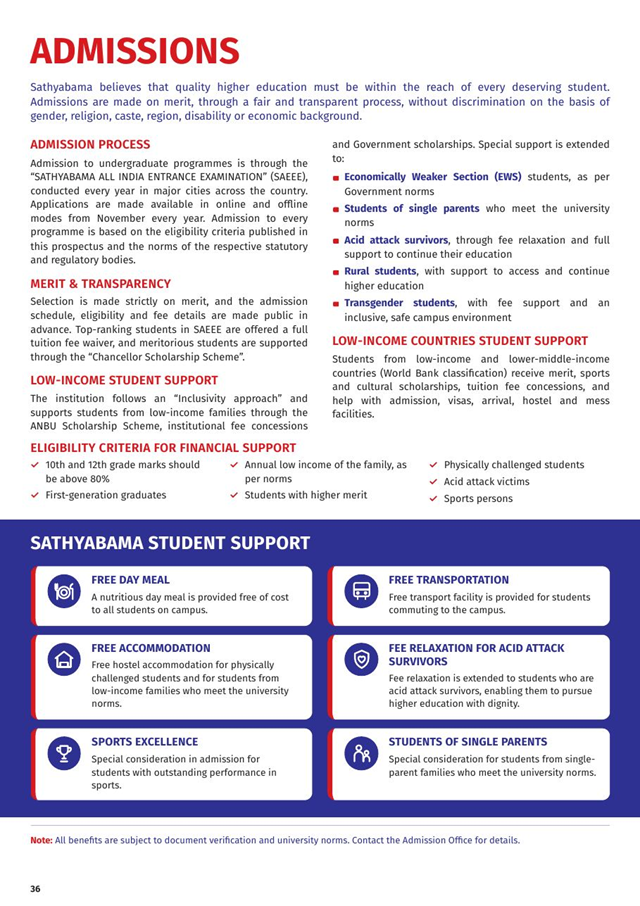
BOTTOM FINANCIAL QUINTILE ADMISSION TARGET Equitable Access to Higher Education How Sathyabama opens its doors to students from the country's lowest-income households, and supports them from admission to graduation. Sathyabama Institute of Science and Technology, Chennai SDG 1 · No Poverty SDG 10 · Reduced Inequalities |

OUR COMMITMENT Sathyabama Institute of Science and Technology has set an institutional target to admit students from the bottom 20% of the country's household income group. A defined share of seats in every year's intake is set aside for these students. Within this group, priority goes to the most disadvantaged: families within the low-income limit as per university norms, Economically Weaker Section (EWS) students, first-generation learners, single-parent households, acid attack survivors and rural students. Every student admitted under this target is supported with fee concessions, scholarships and welfare measures, so that household income never decides who gets a university education. |
01 EQUITABLE ACCESS
Talent is found in every household, whatever its income. Sathyabama's admission policy is built on this belief, and it reserves opportunities for students from the lowest-income fifth of Indian households.The University wants no deserving student to give up higher education for want of money. By actively widening participation from economically weaker sections and socially disadvantaged communities, the policy advances Sustainable Development Goal 1 (No Poverty) and Sustainable Development Goal 10 (Reduced Inequalities).
The admission target is approved by the competent University authority. It is published on the University's official website, so that students, parents and the public can see the commitment and hold the University to it.
02 ADMISSION TARGET FOR THE BOTTOM INCOME GROUP
Every academic year, Sathyabama sets aside a defined share of its total student intake for students from households in the bottom 20% of the national income distribution. The target is approved by the competent University authority and reviewed every year. |
To make sure these seats reach the students who need them most, the University applies a more tightly defined set of priority groups within the bottom income band:
Lowest-Income Families Students whose annual family income falls within the low-income limit as per university norms. | Economically Weaker Sections Students holding a valid EWS certificate, or SC, ST or OBC-NCL certificates, issued under government norms. |
First-Generation Learners Students who are the first in their family to enter higher education. | Single-Parent Households Students raised by a single parent and meeting the University's income norms. |
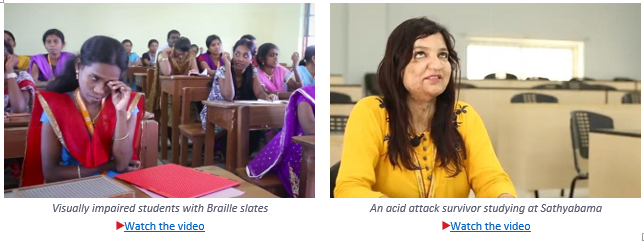
Students Without Parental Support Orphaned students and those with proven ability to study but no parents to support their academic goals. | Acid Attack Survivors, Rural & Other Groups Acid attack survivors, rural students, physically challenged students, victims of violence and others facing economic hardship. |
Seat allocation follows applicable government regulations and the University's approved admission and scholarship policies. Any seats left unfilled in a given year are handled under the approved institutional guidelines.
03 REACHING LOW-INCOME STUDENTS: 2024–2025
The University tracks every year how many low-income students receive financial aid, compared with its total intake. In the academic year 2024–2025:
18,489 Total student intake | 3,329 Low-income students receiving financial aid |
04 ELIGIBILITY AND VERIFICATION
Students applying under this policy must meet the family income criteria and submit supporting documents. Depending on the case, these include:
Income certificate issued by the competent government authority, stating the family's annual income.
Income declaration in the University's prescribed form, giving the income details of parents or guardians.
EWS or community certificate (EWS, SC, ST or OBC-NCL), where applicable.
Proof of status for first-generation learners and students from single-parent households.
Academic records: Class X and qualifying examination mark sheets, or their equivalent.
The Admissions Office checks each document for completeness and authenticity, and may ask for further proof where needed. All personal and financial details shared by applicants are kept strictly confidential.
05 SCHOLARSHIPS FOR LOW-INCOME STUDENTS
Inclusivity is at the heart of Sathyabama, and its Student Scholarship Scheme puts that value into practice. The scheme reaches students from economically weaker sections and differently abled students, regardless of caste or religion. It exists to change lives.
The scheme covers every area of the institution except research scholarships. It supports students with strong academic records who cannot continue for financial reasons, differently abled students, victims of violence, outstanding sportspersons, and capable students who have no parents to support them.
Students can benefit from the ANBU Scholarship, the Chancellor's Scholarship Scheme, NGO-funded scholarships approved by a committee of the Vice Chancellor's office, and Central and Tamil Nadu Government scholarships, awarded as per regulatory guidelines.
How scholarships are awarded
A committee appointed by the Vice Chancellor manages the scheme. It is made up of the Dean (Student Affairs) and two senior faculty members from different disciplines. The committee handles every stage, from inviting applications to selecting recipients and keeping records. Applications open online in March every year, and every application is checked and verified.
Who is eligible
10th and 12th grade marks should be above 80%
First-generation graduates
Annual low income of the family, as per norms
Students with higher merit
Physically challenged students
Acid attack victims
Sports persons
Scholarship links
National Scholarship Portal (NSP)
UGC Scholarships and Fellowships (National Government Services Portal)
india.gov.in: Apply for UGC Scholarships and Fellowships
Government of Tamil Nadu: Pudhumai Penn Scheme
tnsocialwelfare.tn.gov.in: Pudhumai Penn
06 FROM APPLICATION TO ADMISSION
Selection under the policy follows a clear, step-by-step process:
The applicant submits the application form with income, community and academic documents through the admission portal or the Admissions Office.
The Admissions Office checks that the documents are complete and genuine.
Applicants are assessed on family income, academic qualifications and the applicable admission rules.
If there are more eligible applicants than seats, those with the lowest family income are given first preference, followed by academic merit.
The competent University authority approves the final list, and selected students are informed through official channels.
At Sathyabama, a family's income does not decide a student's future. Through this policy, the University makes sure that students from the country's lowest-income households can access, pursue and complete higher education. |
07 SATHYABAMA PROSPECTUS
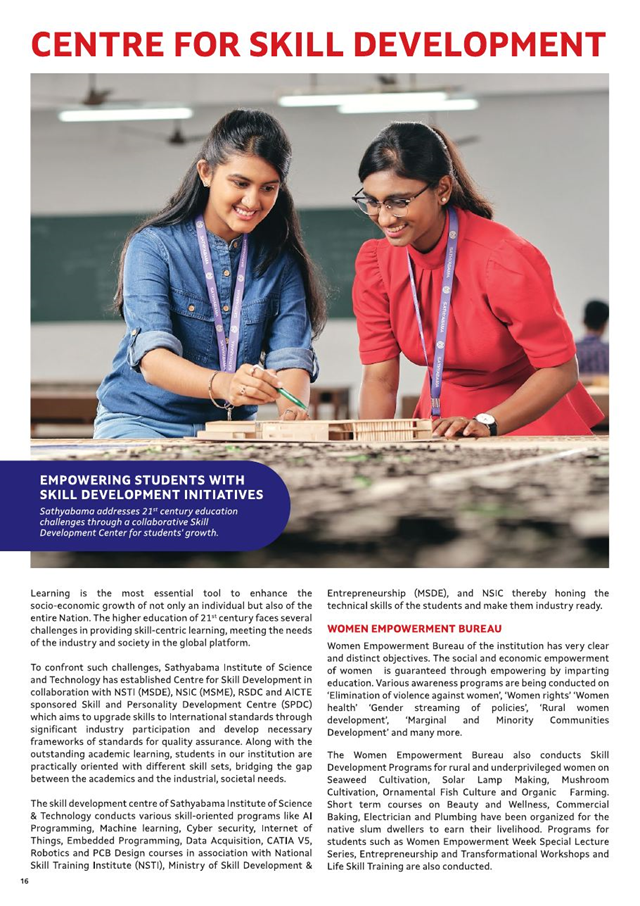
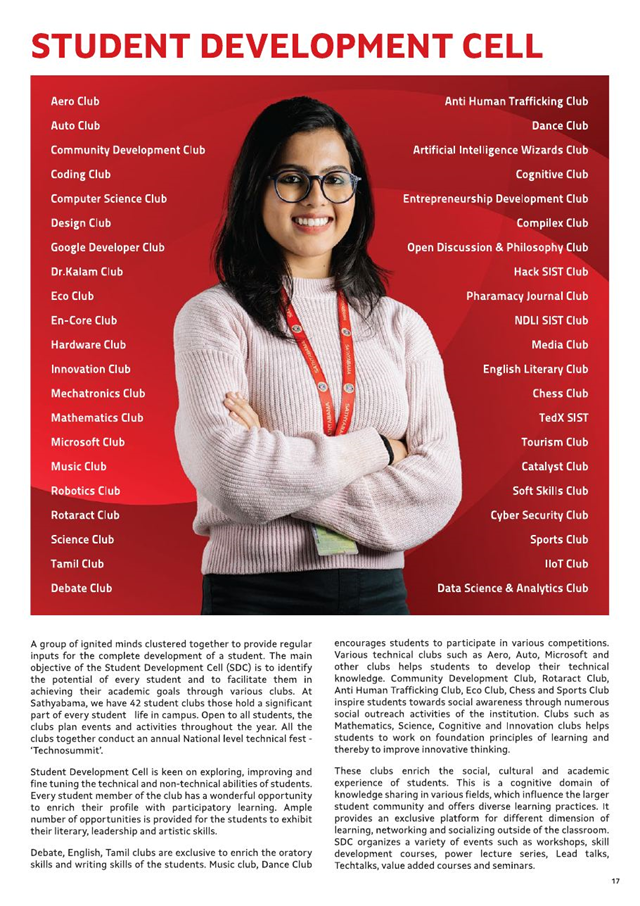
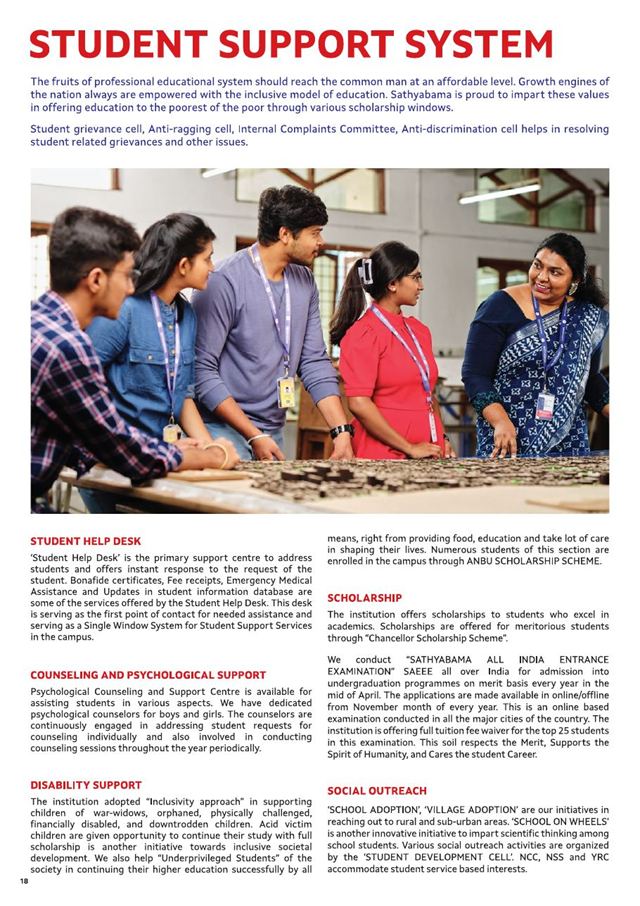
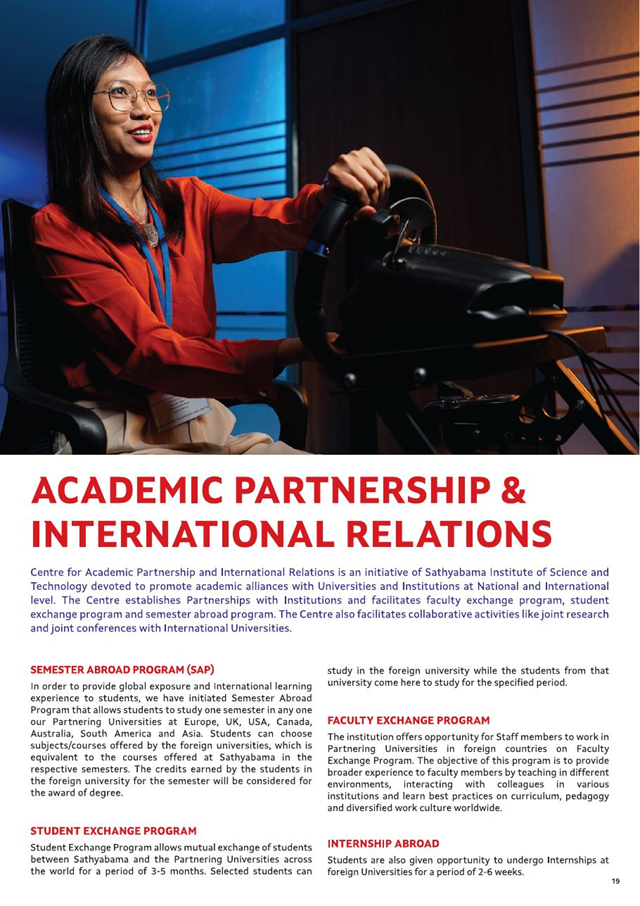

Bottom financial quintile student success
BOTTOM FINANCIAL QUINTILE STUDENT SUCCESS Supporting Every Student to Graduate Graduation and completion targets for students from the country's lowest-income households, and the support that helps them succeed. Sathyabama Institute of Science and Technology, Chennai SDG 1 · No Poverty SDG 10 · Reduced Inequalities |
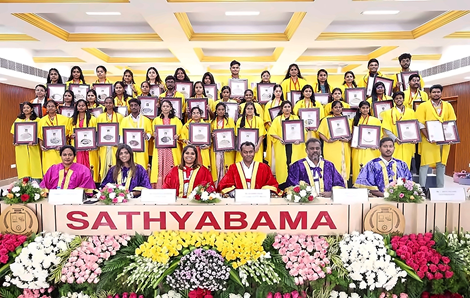
Sathyabama graduates at the University Convocation
OUR COMMITMENT Sathyabama Institute of Science and Technology has set a graduation and completion target for domestic students from the bottom 20% of the country's household income group. The University aims for a success rate of at least 80% among these students, measured as the share of each admission cohort who successfully complete their programme. The University has achieved a success rate of 82%, exceeding its target. |
80% Success rate target for bottom-quintile students | 82% Success rate achieved |
01 MONITORING STUDENT SUCCESS
Every student admitted under these schemes is monitored continuously from admission to graduation. Students who do not meet the academic requirements receive remedial teaching, and financial assistance, mentoring and counselling are provided alongside, so that economic hardship does not stand between a student and a degree.
Monitoring is carried out in the following ways:
Attendance is recorded for every class and reviewed regularly, and students with low attendance are counselled early.
Internal assessment marks and semester examination results are reviewed after every assessment to identify students who are falling behind.
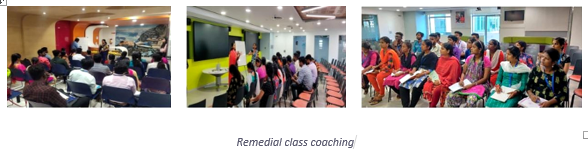
Students who have not met the academic requirements, or who have backlogs, are placed in remedial classes and given additional coaching until they clear their courses.
Each student is assigned a faculty mentor, who meets the student regularly and records the student's academic progress and any personal or financial difficulties.
Parents are kept informed of attendance and academic performance, so that families can support their wards.
The progress of each admission cohort is tracked every semester against the graduation and completion target.
02 GRADUATION AND COMPLETION TARGET
The University has set a target success rate of at least 80% for students from the bottom 20% household income group, and aims for these students to graduate within the normal duration of their programmes. The success rate achieved is 82%. |
Alongside the success rate, the University works towards:
Steady retention and progression of these students from one academic year to the next.
Graduation within the normal duration of each programme.
Additional academic help for students who need more time to complete their programmes.
Career guidance and progression support after graduation.
How success is measured
The success rate is the number of students who successfully complete their programme, compared with the total number of eligible students in the same admission cohort. Results are tracked cohort by cohort and reported against the target every year.
03 SUPPORT SYSTEM
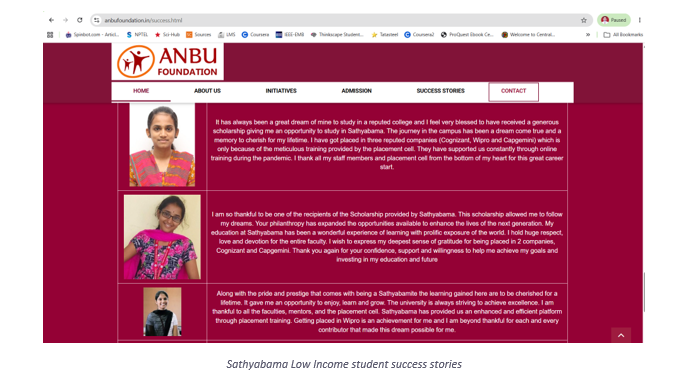
The support system covers students admitted under the University's economically disadvantaged and bottom financial quintile categories, identified through the prescribed annual family income criteria. Through the Anbu Foundation's inclusive education programme, disabled and underprivileged students are educated at Sathyabama every year, including visually impaired students and acid attack survivors.
The support system is built on these principles:
One academic standard: Every student follows the same curriculum, assessments and academic requirements, whatever their financial background.
Extra help where needed: Remedial coaching, mentoring, counselling and learning support for students who need it, including scribes to write examinations for visually impaired students.
Confidentiality and dignity: Students' financial information is kept confidential, and financial status never leads to discrimination or unequal treatment.
Early action: Academic difficulties are spotted early and addressed promptly to protect retention and graduation.
Accessible learning: Braille materials, assistive software and scribes are provided to students with visual impairments.
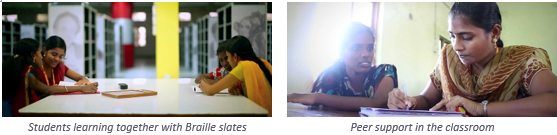
04 SUPPORT THAT HELPS STUDENTS COMPLETE
A complete support framework helps students overcome academic and financial obstacles and stay on course to graduate.
Academic support and remedial coaching
Additional coaching and remedial classes for students who need help completing their courses.
Academic mentoring and individual guidance to strengthen subject understanding and examination performance.
Students are motivated to participate in the international internship and semester abroad with financial support, to get the international exposure.
Mentoring and counselling
Faculty mentors who follow each student's academic progress and help with learning challenges.
Personal counselling and guidance for students facing academic, personal or financial difficulties.
Encouragement to seek help early through the University's academic and student welfare services
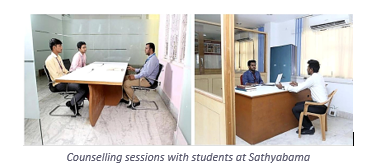
Career development and competitive examination guidance
Career guidance and placement training to improve employability.
Placement and entrepreneurship: Placement support and entrepreneurship guidance help students move into employment or start their own ventures.
Development of communication, presentation, interpersonal and professional skills.
Coaching for competitive examinations such as GATE, CAT and GRE, and Central and State Government recruitment examinations.
Encouragement to pursue corporate careers, government service, postgraduate study, research, entrepreneurship and international education.
Higher studies: Students are guided and supported to take up higher studies opportunities with scholarships through the University's foreign collaborations.
05 MONITORING, EVALUATION AND CONTINUOUS IMPROVEMENT
The concerned academic and administrative authorities regularly review the following indicators:
Overall success rate of students from the bottom financial quintile.
Year-wise academic progression and semester examination performance.
Number of students needing remedial coaching and additional academic support.
Student retention and programme completion rates.
Effectiveness of scholarships, fee concessions and welfare measures.
Graduate progression into employment, higher education and other careers.
Actual results are compared with the institutional target of an 80% success rate. Where outcomes fall short, corrective measures are identified and put in place. The support system and its implementation are reviewed periodically to strengthen academic support, improve retention and ensure successful programme completion.
At Sathyabama, success is measured not only by who enters, but by who graduates. Through the Anbu Foundation and its student support system, the University makes sure that students from the lowest-income households complete their education and move on to better opportunities, advancing SDG 1: No Poverty.
Low-income student support
LOW-INCOME STUDENT SUPPORT Support That Sees Every Student Through to Graduation Food, housing, transportation, financial aid, counselling and grievance support for students from low-income families. Sathyabama Institute of Science and Technology, Chennai SDG 1 · No Poverty SDG 10 · Reduced Inequalities |
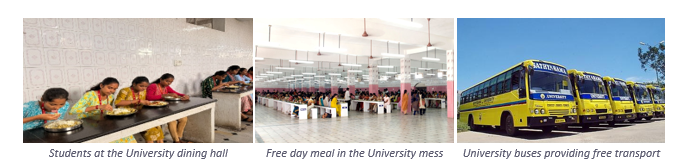
OUR COMMITMENT Sathyabama Institute of Science and Technology provides practical support so that students from low-income families can complete university. Every student receives a free day meal and free transportation. Physically challenged students and students from low-income families who meet university norms receive free hostel accommodation. These measures are backed by scholarships, fee concessions, help with government schemes and education loans, counselling, and grievance support. |
Free Day meal for every student | Free Transportation for every student | 3,329 Low-income students receiving financial aid (2024–25) |
01 OVERVIEW
No student at Sathyabama should have to leave their studies because of the cost of food, travel or a place to live. The University removes these everyday barriers so that students from economically disadvantaged backgrounds can attend classes, take part in campus life and complete their programmes.
The support described here reduces the financial burden on students and their families, promotes equal educational opportunity, and improves student retention and programme completion. It advances Sustainable Development Goal 1 (No Poverty) and Sustainable Development Goal 10 (Reduced Inequalities). All financial and personal information shared by beneficiaries is handled confidentially.
02 SUPPORT AT A GLANCE
The following support is provided to students, subject to university norms and verification of documents.
Support | What students receive | Who is eligible |
|---|---|---|
Food | A free nutritious day meal through the University mess, reducing daily food expenses. | All admitted students, ensuring equality on campus. |
Transportation | Free travel in university buses between the campus and designated routes and pick-up points. | All admitted students, ensuring equality on campus. |
Housing | Free hostel accommodation | Physically challenged students, and students from low-income families who meet university norms. |
Scholarships and fee support | ANBU Scholarship, Chancellor's Scholarship Scheme, fee concessions, and fee relaxation for acid attack survivors. | Students meeting the eligibility criteria, with priority for low-income families. |
Government schemes and loans | Help in identifying, applying for and following up government scholarships, and guidance on education loans. | All students, with priority assistance for students from low-income families. |
Counselling and grievance support | Psychological counselling, the Student Help Desk, and grievance, anti-ragging, anti-discrimination and complaints committees. | All students. |
03 FOOD, TRANSPORTATION AND HOUSING
Free day meal
Every admitted student receives a free, nutritious day meal through the University mess. Making the meal free for all students removes a daily expense for low-income families, and no student is singled out because of their background.
Free transportation
University buses carry students free of charge between the campus and designated routes and pick-up points. This saves families a significant monthly cost and makes daily attendance possible for students living far from campus, including those from rural areas.
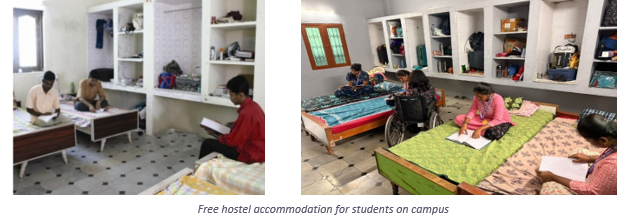
Free hostel accommodation
Free hostel accommodation is provided to physically challenged students and to students from low-income families who meet university norms. A safe place to live on campus lets these students focus fully on their studies.
04 SCHOLARSHIPS AND FINANCIAL ASSISTANCE
Sathyabama's scholarships reach students from economically weaker sections without bias of caste or religion. Students can benefit from the ANBU Scholarship Scheme, which supports underprivileged students with food, education and care, the Chancellor's Scholarship Scheme, NGO-funded scholarships approved by the Vice Chancellor's office, and Central and Tamil Nadu Government scholarships.
Through its Low-Income Student Support, the University gives special assistance to:
Economically Weaker Section (EWS) students, as per government norms.
Students of single parents who meet university norms.
Acid attack survivors, through fee relaxation and full support to continue their education.
Rural students, with support to access and continue higher education.
Help with government scholarships and education loans
The Scholarship and Financial Aid Cell help students make full use of external funding:
Awareness: Information on government, state and institutional scholarships is shared through orientation programmes, notices and official channels.
Application help: Students are guided through applications, obtaining income and category certificates, and uploading documents on the relevant online portals.
Follow-up: Students are helped to track their applications and resolve document issues or delays.
Education loans: Information and step-by-step guidance on loans from banks and recognised financial institutions.
Other assistance: Students are told about other institutional or external support that can help them continue their education.
05 COUNSELLING AND GRIEVANCE SUPPORT
Financial hardship often brings personal and academic pressure. Sathyabama supports the whole student:
Psychological counselling: Dedicated counsellors for boys and girls hold individual and group sessions throughout the year.
Student Help Desk: A single-window first point of contact for students needing help, including certificates, fee receipts and emergency medical assistance.
Grievance support: The Student Grievance Cell, Anti-ragging Cell, Internal Complaints Committee and Anti-discrimination Cell protect students' rights and resolve their grievances.
Faculty mentoring: Mentors follow each student's progress and connect them with academic, financial or personal help early.
06 CAREER DEVELOPMENT, ENTREPRENEURSHIP AND COMPETITIVE EXAMINATION GUIDANCE
Career guidance and placement training to improve employability.
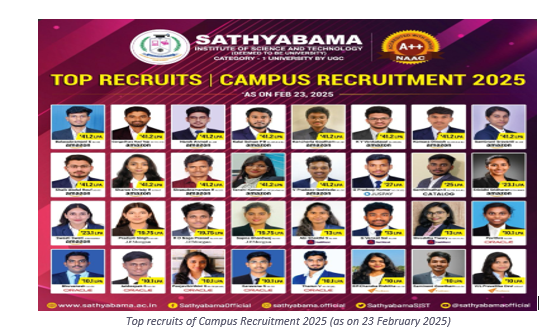
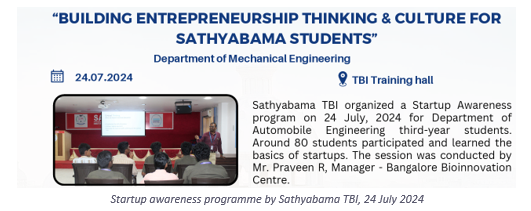
Placement and entrepreneurship: Placement support and entrepreneurship guidance help students move into employment or start their own ventures.
Development of communication, presentation, interpersonal and professional skills.
Coaching for competitive examinations such as GATE, CAT and GRE, and Central and State Government recruitment examinations.
Encouragement to pursue corporate careers, government service, postgraduate study, research, entrepreneurship and international education.
Higher studies: Students are guided and supported to take up higher studies opportunities with scholarships through the University's foreign collaborations.
07 HOW STUDENTS ACCESS SUPPORT
Students apply for support through a simple, confidential process:
Submit documents: A valid income certificate from the competent authority. Students applying for free hostel accommodation as physically challenged students also submit a valid disability certificate.
Verification: The designated University office verifies the documents and confirms eligibility against university norms.
Confirmation: Eligible students are informed of the support approved and how to use it.
Access: Meal and transport benefits are provided through the student identity card or pass system. Hostel accommodation is arranged through the hostel administration.
Semester-wise review: Eligibility is reviewed periodically, where required, using updated income and supporting documents.
Every step respects students' privacy and dignity, and ensures equal access to welfare facilities.
At Sathyabama, a family's income should never decide whether a student eats, travels, finds a home on campus or completes a degree. Through this support, the University makes sure that every student can stay, learn and graduate, advancing SDG 1: No Poverty. |
Bottom financial quintile student support
BOTTOM FINANCIAL QUINTILE STUDENT SUPPORT Helping Every Student Complete Their Studies Scholarships, government schemes, education loans and paid campus work for students from the country's lowest-income households. Sathyabama Institute of Science and Technology, Chennai SDG 1 · No Poverty SDG 10 · Reduced Inequalities |
OUR COMMITMENT Sathyabama Institute of Science and Technology runs dedicated programmes so that students from the bottom 20% of the country's household income group can pay for, stay in and complete their studies. Institutional and government scholarships, education loan assistance and paid work on campus remove the financial pressure that most often forces these students to leave before graduating. |
01 OVERVIEW
For a student from a low-income household, the greatest risk to completing a degree is cost. Sathyabama therefore supports these students financially from the first year to the last, through four programmes: institutional scholarships, government scholarship schemes, education loan assistance and the Earn While You Learn programme. Students are identified through family income, background and academic performance, and are screened by a committee constituted by the Vice Chancellor.
02 INSTITUTIONAL SCHOLARSHIPS
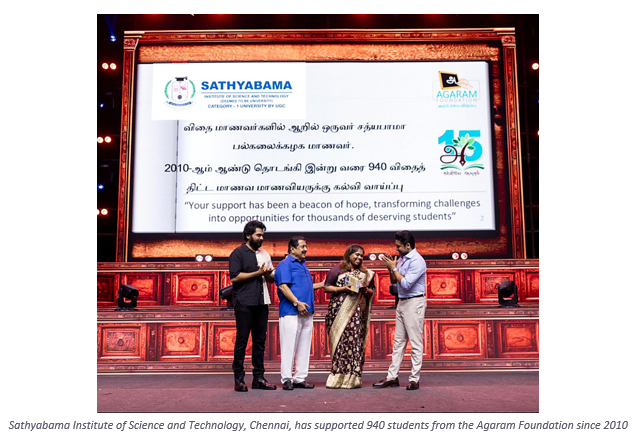
Sathyabama's own scholarships reach students from economically weaker sections without bias of caste or religion. Working with NGOs, the University identifies underprivileged and meritorious students who lack the financial support to continue their education. Deserving students from rural areas, economically weaker sections and first-generation learners receive a 100% scholarship. Scholarships are also offered to the children of Indian Defence personnel, destitute women and war widows, and prison inmates.
The main institutional scholarships are:
Anbu Scholarship Scheme: Supports underprivileged students with education, food and care, from the first year of their programme to the final year.
Chancellor's Scholarship Scheme: Supports meritorious students who lack the financial means to continue their education, renewed each year of study.
Sathyabama Scholarship: Recognises and supports deserving students during their programme.
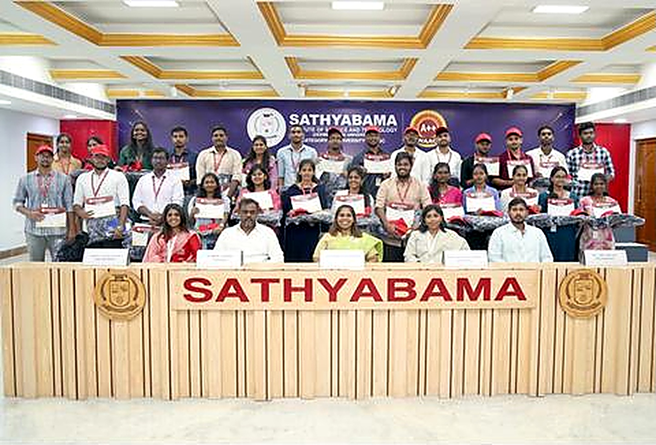
Chancellor's Scholarship ceremony, 4 July 2024: scholarships distributed to students
03 GOVERNMENT SCHOLARSHIP SCHEMES
The Scholarship and Financial Aid Cell helps students secure Central and Tamil Nadu Government scholarships, guiding them through applications, certificate verifications and follow-up. Students benefit from schemes including:
| Scheme |
|---|
| Moovalur Ramamirtham Ammaiyar Ninaivu Puthumai Penn Thittam |
| Tamil Pudhalvan Scheme |
| AICTE - Pragati Scholarship Scheme for Girl Students (Technical Degree) |
| Central Sector Scheme of Scholarships for College and University Students |
| Financial Assistance for Education to the Wards of Beedi/Cine/IOMC/LSDM - Post Matric |
| Post Matric Scholarship for Students with Disabilities (Tuition fee) |
| Prime Minister's Scholarship Scheme for Central Armed Police Forces and Assam Rifles |
| Prime Minister's Scholarship Scheme for Ministry of Railways |
| Lakshadweep Scholarship Scheme |
Government scholarships received by Sathyabama students in the academic year 2024–25
04 EDUCATION LOAN ASSISTANCE
Students who need further funding to begin or continue their programme are supported by the Loan Assistance Cell, which:
Shares information on education loan schemes from recognised banks and financial institutions, including banks near the campus.
Explains the application procedure and the documents lenders require, and guides students through each stage of loan processing.
Liaises with banks, where needed, so that students secure a suitable loan without interrupting their studies.
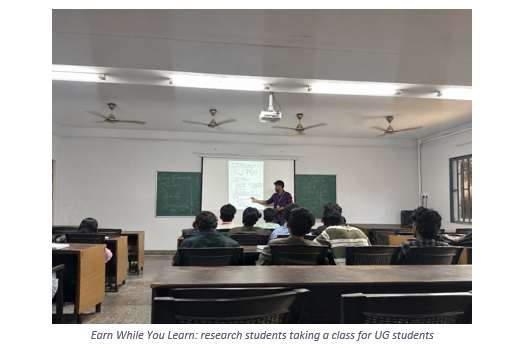
05 EARN WHILE YOU LEARN
The Earn While You Learn programme offers students paid work in lecturing, so that they can support themselves while they study. Eligible students are engaged to teach and explain subject concepts to their juniors and peers in classroom and tutorial sessions, under the guidance of faculty. Teaching hours are limited each week so that the work never comes before their own studies. Lecturing builds the students' subject mastery, confidence and communication skills, while the income they earn eases the cost of their education. Opportunities are announced through official channels, and applications are reviewed and approved by the designated office. Research Scholars are supported with stipend to support their financial needs.
06 HEALTH CARE AND MEDICAL SUPPORT
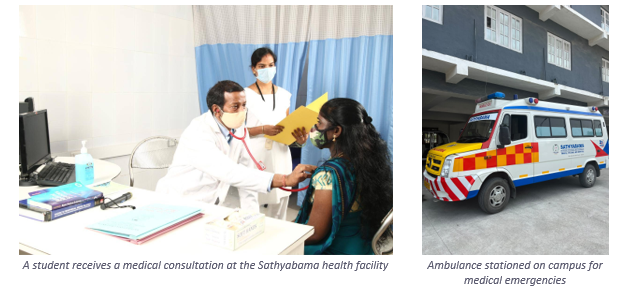
Falling ill should never cost a student their studies or their savings. Sathyabama provides medical care inside the campus, round the clock, so that students from low-income households can get treatment without travelling or paying for private care, and can return to class quickly.
On-campus hospital and medical rooms
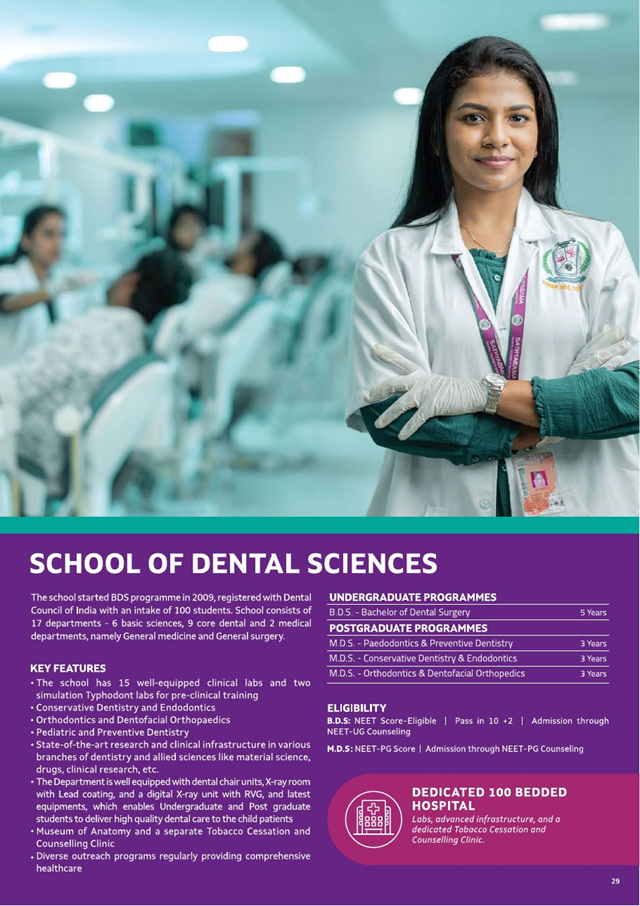
General Hospital on campus: Sathyabama runs a 100-bed General Hospital on campus, with medical and paramedical staff, that serves students, staff and the general public.
Full range of services: An outpatient department, an emergency department, a pharmacy, a laboratory, diagnostic services including radiology and angiography, physiotherapy, dental care, an obstetric unit, and operating and recovery rooms.
Medical rooms for students: Separate medical rooms and dispensaries for boys and girls are located inside the institute, and full-time medical officers are available on campus to care for students.
Doctors and nurses 24x7: Doctors and nurses are on duty round the clock, and the hostels have a 24x7 medical room, so help is available at any hour.
Free medicines: Students who fall ill receive medicines free of charge, which removes a cost that low-income families often cannot meet.
Ambulance service: Two ambulances are stationed on campus for emergencies.
Support for girl students in medical emergencies
Girl students have dedicated medical support on campus, so that they can seek care promptly and comfortably, including in an emergency:
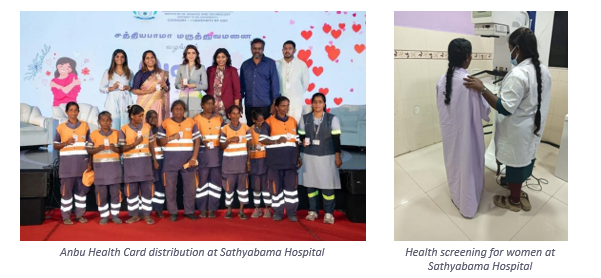
Anbu Health Card: ANBU health cards were distributed to girl students, women staff members and women from public life, providing access to healthcare services at Sathyabama Hospital, including mammograms, blood investigations, diabetes screening, eye care, oral health examinations, abdominal scans and haemoglobin assessment.
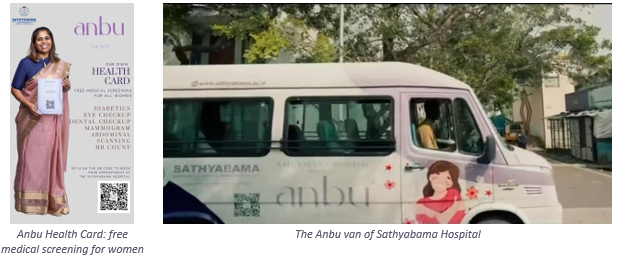
Separate medical room for girls: Girl students have their own medical room and dispensary inside the institute, and a 24x7 medical room in the girls' hostels.
Emergency response at any hour: In a medical emergency, a girl student can reach the medical room or the hospital's emergency department at any time of day or night, and the campus ambulances take her to the hospital when needed.
Women's health care: The campus hospital's obstetric unit and specialist services are available for conditions that need further care.
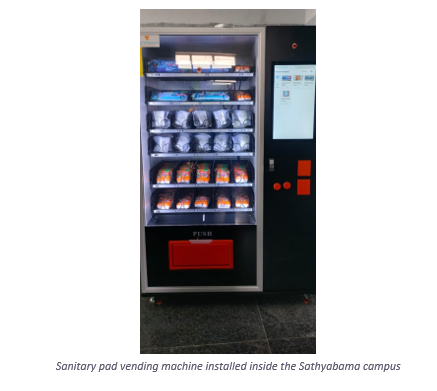
Menstrual hygiene: sanitary pad vending machine
A sanitary pad vending machine is installed inside the campus, so that girl students can obtain sanitary pads immediately and discreetly when they need them, including during a menstrual emergency. Easy access to sanitary products means that girls do not have to miss classes, leave the campus or depend on others for a basic need, which supports their attendance and their dignity.
07 COMPLETING THEIR STUDIES
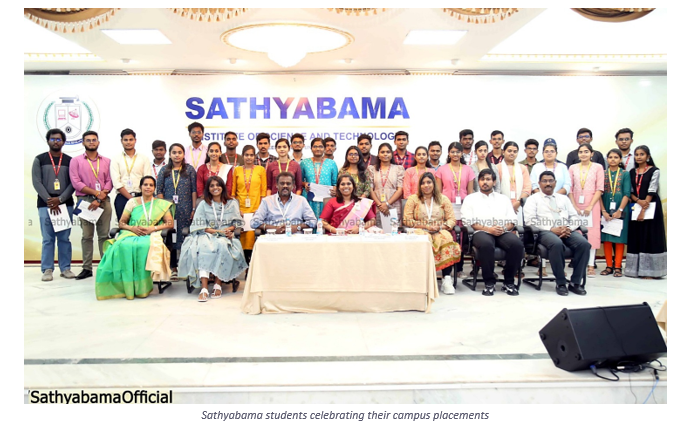
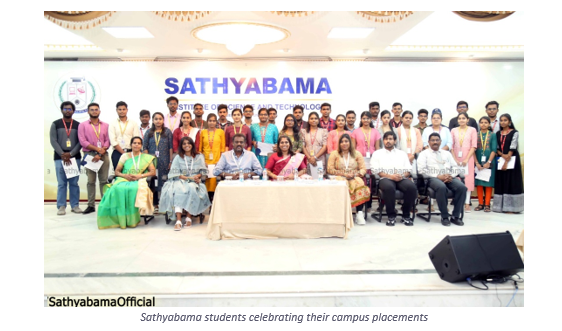
Financial support works alongside the University's academic mentoring, remedial coaching and free meal, transport and hostel support, so that bottom-quintile students can stay on course until graduation. The University reports a success rate of 82% for these students, above its 80% target. Students who joined through the full scholarship scheme have gone on to graduate and secure jobs through campus placements.
At Sathyabama, a family's income should never decide whether a student graduates. Through these programmes, students from the country's lowest-income households have the support they need to complete their studies, advancing SDG 1: No Poverty. |
Low or lower-middle income countries student support
LOW OR LOWER-MIDDLE INCOME COUNTRIES STUDENT SUPPORT Opening Sathyabama to Students from Developing Nations Scholarships, fee support and settling-in help for students from low-income and lower-middle-income countries. Sathyabama Institute of Science and Technology, Chennai SDG 1 · No Poverty SDG 10 · Reduced Inequalities |
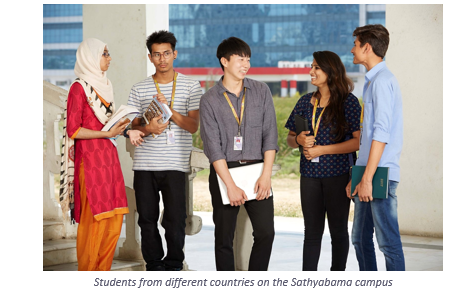
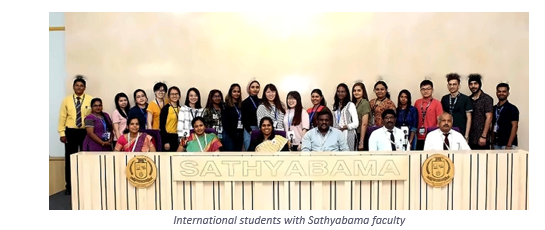
OUR COMMITMENT Sathyabama Institute of Science and Technology has dedicated schemes to support students from low-income and lower-middle-income countries, as classified by the World Bank. Eligible students receive tuition fee concessions through merit, sports and cultural scholarships and an Outstanding Academic Achievement Award. They are also helped with admission, visas, arrival and orientation, and given access to hostel accommodation and mess facilities, so that limited means do not prevent them from completing a degree. |
01 WHO IS ELIGIBLE
The schemes are open to students who are citizens of SAARC countries and countries classified by the World Bank as low-income or lower-middle-income, and who meet the University's admission requirements for their chosen programme. The list of eligible countries follows the World Bank's official income classification and is updated whenever that classification is revised.
By opening its doors to talented students from developing nations, the University helps build skills and opportunity where they are needed most, in line with Sustainable Development Goal 1 (No Poverty) and Sustainable Development Goal 10 (Reduced Inequalities).
02 SCHOLARSHIPS AND FEE SUPPORT
Eligible international students can receive the following financial support, subject to institutional guidelines and eligibility conditions.
Scheme | Support provided | Who qualifies |
|---|---|---|
Merit-Based Scholarship | Tuition fee concession. | Students with outstanding results in their qualifying examination or entrance test. |
Sports and Cultural Scholarship | Financial assistance towards fees. | Students with recognised achievements at state, national or international level. |
Outstanding Academic Achievement Award | Tuition fee support for selected high-performing applicants. | Top applicants from eligible countries. |
COMPEX Nepal Scholarship | Government of India scholarship for undergraduate study in engineering, agriculture, nursing and pharmacy. | Nepalese students selected through the COMPEX scholarship examination of the Embassy of India, Kathmandu. |
e-VBAB Network Project | 100% Government of India scholarship for Sathyabama's online undergraduate and postgraduate degree programmes. | Students from partner African countries who enrol through the e-VidyaBharati and e-ArogyaBharati (e-VBAB) portal. |
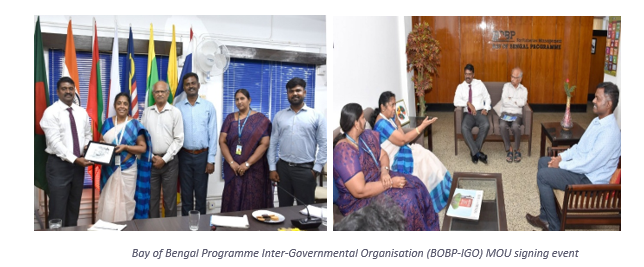
Bay of Bengal Programme Inter-Governmental Organisation (BOBP-IGO) | Full scholarships for research students. | Research students from countries of the Bay of Bengal region, under the University's MoU with BOBP-IGO. |
Renewable scholarships continue across the programme and are reviewed periodically on the basis of academic performance and other applicable conditions, so that students can plan their full course of study with confidence.
03 ADMISSION AND SETTLING-IN SUPPORT
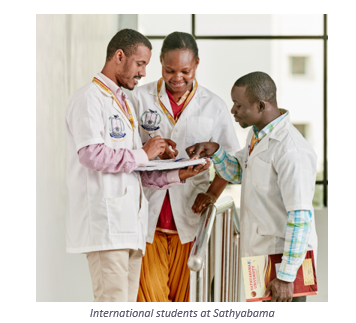
Moving to a new country is a big step. The International Admissions Office supports students from their first enquiry to their first semester:
Admission guidance: Help with choosing a programme and completing admission formalities.
Visa assistance: Guidance on visa procedures and the documents required.
Arrival arrangements: Support with travel and arrival in Chennai.
Orientation: An introduction to the University, its academic system and campus life.
Access to facilities: Help in registering for and using University facilities from day one
04 ACCOMMODATION AND FOOD
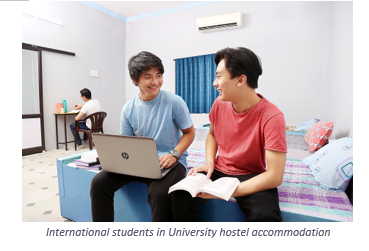
International students are helped to secure a place in the University hostels and to use the mess facilities, subject to availability and applicable charges. They also receive the free day meal provided to every Sathyabama student. Living on campus keeps costs predictable and places students close to classrooms, laboratories and libraries.
05 HOW TO APPLY
Students apply through the Study in India portal or the International Admissions Office:
Submit documents: Academic records, passport details, and financial-need or achievement certificates relevant to the chosen scheme.
Evaluation: The scholarship committee assesses each application on academic merit, financial need and the scholarship criteria.
Decision: Successful applicants are informed of the support awarded and the next steps for admission.
Renewal: Renewable scholarships are reviewed periodically against academic performance and other conditions.
Study in India: Students who apply through the Study in India programme receive a tuition fee concession.
06 MONITORING AND REVIEW
The International Admissions Office keeps records of:
Applications received from students of eligible countries.
Admissions granted.
Scholarships awarded.
Total financial assistance and tuition fee concessions provided.
The scholarship committee reviews these records every year to assess how well the schemes are working and to improve them. Details of the schemes and their implementation are published on the University's official website.